Shades, sleeping ponies and the dreaded New Forest fly

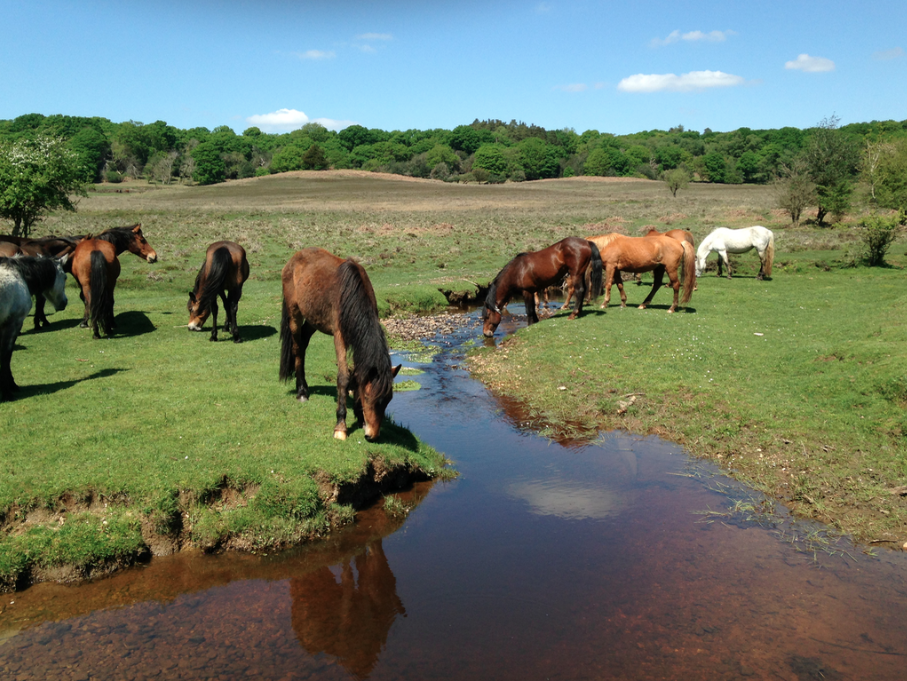
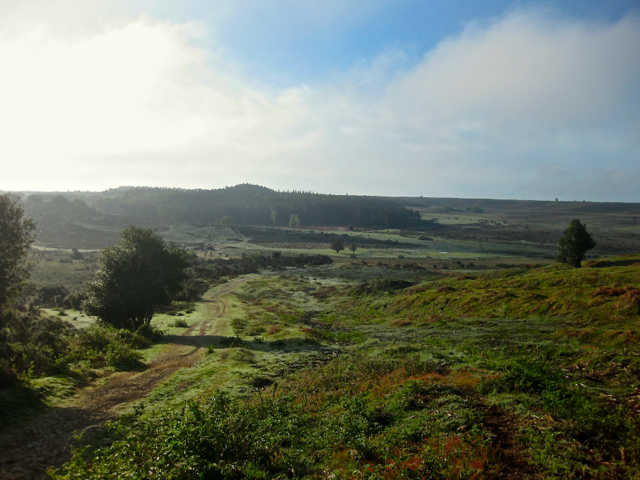
In the heat of the day the ponies seek relief in areas known as 'shades' but not all of there are under trees.

In the heat of the day the ponies seek relief in areas known as ‘shades’ but not all of these areas are under trees.

The warm weather of late has driven the ponies to find relief from the sun and the heat of the day. They gather together in places known as ‘shades’ that, unlike the name would suggest, aren’t always under the cover of trees. Some of the shades frequented by the ponies are out in the open but will have a discernable breeze that keeps them cool. Often too you will see ponies lying flat out quietly snoozing in the sun. This surprises people, as they generally believe that horses and ponies sleep standing up. I’ve met several visitors who believe that they have seen ‘dead’ ponies on the Open Forest and I have no doubt that other commoners and the Agisters will have encountered the same concerns. However, if you wait quietly and watch the ponies as they sleep, for though they seem dead to the world, the occasional flick of the ear or even a slight lift of the head to have a look around will indicate that they have been in a deep slumber. Ponies can doze whilst standing but to get a really good rest they need to sleep lying down. In the herd environment one of the ponies will stand sentinel and keep a look out while the others lie down and rest.

Airborne pests
Flies are very active at this time of year and swarm around the ponies in great numbers. The ponies that roam freely on the New Forest have every opportunity to protect themselves from these airborne pests, unlike many of their domestic counterparts. The wild ponies can seek shelter in the gorse or under trees and act cooperatively to relieve themselves from the worse of the swarm. The herd will stand close together and accept the benefit of a companion’s tail to swot the flies away while one of their herd-mates receives the same from them. The ponies know where to stand when the flies are at their most tormenting and will seek out the insect-free breezes that criss-cross the valleys and hill tops even on the stillest days. Visitors to the Forest will notice that some of the ponies often stand beside the roads with their heads facing the traffic. They’ve learned that the back-draft from passing vehicles is also a good tactic for reducing pestering flies.

The dreaded Forest fly
The biggest menace in terms of flying insects that prey upon equines is the dreaded ‘crab fly’, or ‘Forest fly’ (Hippobosca equina) as it is also known, which is generally only found on the New Forest. These tenacious little devils cling on determinedly to their unfortunate hosts and travel, as one observer describes, by ‘making tracks under the ponies coat like a deer wandering through a field of corn’. I have heard tales of visiting horses being brought to the New Forest driven half mad with terror by the sensation, and normally quiet animals being rendered unrideable. Stories are even told of times past when New Forest ponies used for transport to other areas would inadvertently carry the flies away with them. As the flies moved onto the town animals all pandemonium would ensue, with the horses harnessed to tradesman’s vans, milk carts and drays bucking or bolting and causing widespread panic. The ponies born and bred on the Forest are accustomed to these pests and do not react so dramatically to them. Not all the victims of the Forest fly were equine though. Naughty Forest boys were said to collect them to put them in girls’ hair as a prank. However, although the Forest fly is a bloodsucker, most observers agree that its sideways moving method of travel is far more alarming to its host than its bite.

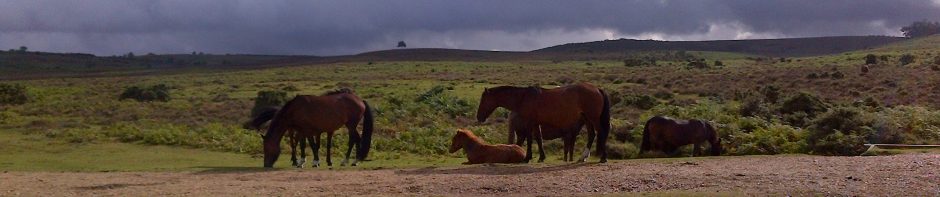
Ponies doze standing up but to get a really good sleep they need to lie down.

Ponies doze standing up but to get a really good sleep they need to lie down.

Posted in New Forest, New Forest pony | Tagged , , , , , , , | Leave a comment

New Forest: mining and pit ponies

Commoning is a very sociable enterprise, wherever they get together.

In times past many New Forest ponies were sold for working in the mines.

I was interested in a recent news item (June 2014) that reported the potential re-opening of mines in Cornwall. The demand for metal in China and the developing world has inflated the price of tin making its recovery more profitable. Cornish mine owners are being tempted to revive an industry that was abandoned as uneconomic decades ago. Apparently the owners of some coalmines are also undertaking the same deliberations.

Relentless toil performed by ponies
Mining was an industry that was very labour intensive and ponies were recruited to work alongside the men deep underground. Thousands of New Forest ponies were among the ranks of other native breeds, including Shetland, Welsh and Dartmoor ponies to work in this demanding and dangerous industry. Pit ponies were not allowed to work in the mines until they were four years old and only stallions or geldings were generally used. They had to be sure-footed and strong, to cope with the heavy, relentless work. The temperament of the pony was very important, a good pit pony had to be even-tempered and gentle, as wilful or spirited horses were a danger to the drivers and could cause injuries to themselves and others, possibly with fatal results. New Forest ponies, with their easy-going manners and versatile natures, were ideally suited to the harness work required in the mines. Consequently the buying agents from the coalmines were regular visitors to the New Forest pony sales.

The treatment of the ponies
What you hear about the treatment of the ponies, as they toiled underground, will depend very much upon whom you speak to. The official version from the privatised mine owners, and then the nationalised Coal Board, would prefer you to believe that the health of every single pony was carefully monitored and that their well being was paramount. The miners themselves tell different and sometimes harrowing stories where profit was paramount not ponies. What is without dispute, however, are the strong bonds established between the miners and the ponies. Many stories are recounted of ponies saving miners and miners losing their lives to save their ponies during underground fires, cave-ins or other traumatic incidents.

Thousands of pit ponies working underground
According to the National Coal Mining Museum for England, the number of working ponies reached a peak just before World War I, with 70,000 ponies in 1913. After this the number declined, initially due to the demands of the War, and after that, because of the machinery that was being introduced. This meant that by 1932, only 32,000 ponies were used by mines. In 1947, the coal industry in the UK was nationalised. This made the process of modernisation quicker, and so fewer ponies were needed to labour underground. By 1962, only 6,400 ponies were used underground, and the number continued to drop. In 1978 there were only 149 ponies employed to work underground. A very small number of mines continued to employ ponies until the 1990s.

Reawakening of the mines
When the pits closed the mining communities were devastated. Many generations of the same families had worked underground.  Mining provided social and cultural identity as well as food on the table. The reawakening of the mines will certainly have implications for the communities that relied upon the jobs and economic benefits provided by mining.  I will watch with interest to see if the same reawakening has an impact on the demand for New Forest ponies to be, once more, colleagues and companions to the miners.

Thousands of New Forest ponies were used in the mining industry.

New Forest ponies were favoured because of their work ethic and kindly natures.


Posted in New Forest pony | Tagged , , , , , , , | Leave a comment

New Forest: the benefits of nature

The benefits of nature to human health and well-being have long been known.

The benefits of nature to human health and well-being have long been known.

Like most commoners I work full-time in a job that is not related in any way to the New Forest. Recently I’ve been travelling more and more to London for various meetings and events. Witnessing the hectic pace of city life on the capital’s streets is guaranteed to have me counting my blessings and being thankful for living in a quiet rural community. The benefits of living in the countryside have long been acknowledged and various studies have confirmed that exposure to nature, even in the form of a window box, is good for our physical, mental and emotional health. Communities that are bereft of greenery, in the form of trees, grasses and flowers, are also more likely to experience higher levels of crime, anti-social behaviour and poor health.

The exodus from the countryside initiated by the Industrial Revolution, which began in the mid-1700s, also signalled the divorce from knowledge of food production, animal husbandry and herb-lore. People moved away from the rural landscape to live in large cities or tight-knit communities surrounding the factories, mines and foundries where they worked. Such concentrated living conditions gave very little opportunity for interacting with the natural world. A consequence of this is that today we are faced with a reality where our species has the least engagement with plants and animals than it has ever had in the history of our evolution. No one knows what the long-term effect of this disconnection with nature will have.

For me such issues make the preservation of the New Forest, and the commoning activities that conserve it, a top priority. The Forest is an ancient landscape that has survived into modern times and maintains a diverse collection of irreplaceable habitats and wildlife species. The commoners of the New Forest have been practicing a pastoral way of life for over 1000 years and have an intimate connection with the landscape that has even been described as symbiotic. As I look out of the carriage window on my train journeys to and from London I see more and more housing or commercial developments gobbling up the land. Fields of crops, orchards and grazing land are being replaced by tarmac and block paving. I say a silent prayer to myself in the hope that our species does not become so divorced from nature that we believe we can do without it altogether.

City life moves at a hectic pace.

City life moves at a hectic pace.


Posted in New Forest, New Forest Commoner | Tagged , , , , , , , , , , , | Leave a comment

Stallions on the New Forest

A stallion takes a drink – chasing mares is thirsty work!

There has been a lot of excitement on the New Forest recently due to the stallions being released onto the Open Forest. This is an annual event and, this year (2014), ten male ponies have been turned out to run with the free-roaming mares. The stallions are permitted to roam for four weeks only and thus have a short window of opportunity to provide the next generation of New Forest pony. Each stallion is carefully vetted by the Verderer’s of the New Forest and the New Forest Pony Breeding & Cattle Society to ensure that the best qualities, in terms of confirmation, temperament, stamina and such like, are passed on to the foals. Only stallions passing inspection are permitted to run on the Open Forest. By controlling the number released and the length of time each stallion is permitted to roam the Forest, it is hoped that the number of foals produced will be fewer but of better lineage and confirmation, and therefore in greater demand. This is how the population of the New Forest ponies is managed today – and not by culling, as happens in some wild horse populations in other countries – however, there were attempts in Tudor times to improve the breed by slaughtering smaller, under-height animals.

Census and slaughter of ponies
In the Horse Act 1540 Henry VIII decreed that an annual census be held at Michaelmas tide to weed out and slaughter “all unlikely tits whether mares or foals”, from which todays system of drifts derives.  The Act ordered that no stallion under 15 hands and no mare under 13 hands was permitted to run out on common land or run wild. However, the annual cull of “under-height” horses demanded by her father was partially repealed by Queen Elizabeth I in 1566, as it was recognised that the poor soils of the New Forest could not produce the grazing required to sustain larger animals.(The commoners had ignored the order to kill their ponies in any case.) Other attempts to introduce other qualities into the New Forest pony breed, such as speed, height or appearance, have included mixing in other native breeds, such as Dartmoor, Welsh and Exmoor, and even thoroughbred and Arabian horses. In 1765 the thoroughbred stallion, Marske was used on New Forest mares but when one of his foals, Eclipse, turned out to be a racing legend he was swiftly returned to racehorse stud duties.

Surviving on the Forest
In the Victorian era Arabian stallions were borrowed from the royal stud to sire foals with New Forest mares. This scheme did not prove popular with the commoners. The stallions found it difficult or even impossible to survive on the Open Forest, and so were used on stud farms to which most commoners mares did not have access. The commoners wanted a more robust influence on the New Forest breed and this they got in the form of the Forest itself. One commentator observed that the power of Nature tends to ‘grind down and assimilate these types to the one most suited to the land’. The New Forest pony makes the landscape and the landscape makes the New Forest pony. Although another observer remarked wryly that it wasn’t the fastest, best looking or even the noblest stallion that produced the future generation of New Forest foals. It was in fact the dirtiest fighter!

During the drifts ponies are checked for health.

During the drifts ponies are checked for health.

From Monday 19th May stallions were turned out on the Open Forest and will run with the mares until Monday 16th June. The areas with free-roaming stallions can be viewed on the following link: http://newforestcommoner.wordpress.com/2014/05/21/new-forest-stallion-areas-2014/

Posted in New Forest, New Forest pony, New Forest Pony Drift | Tagged , , , , , , , , , , , , , , , , , , , | Leave a comment

New Forest Stallion Areas 2014

Each year stallions are released onto the Open Forest to run with the free-roaming mares and sire the next generation of New Forest pony. The stallions are carefully selected by the Verderer’s of the New Forest and the New Forest Pony Breeding & Cattle Society. Only approved stallions are permitted to breed and will run with the mares for only four weeks. All stallions must be removed from the Forest by Monday 16th June.

The 2014 stallion areas are:
Name of stallion      –     Location

Applewitch Diversity – Ashley Fields

Halestorm Branston Pickle
– Pilley

Portmore Downpour – High Corner / Broomy

Cadland Masterplan – Matley

Sturtmoor Top Hat – Hale Purlieu

Lucky Lane Rollo – Durhill

Sway Mister Blue Sky – Shirley Holmes

Walhampton Scholars Farewell – Moonhills

Ashdene Record – Wootton

Bakeburn Benny – Millyford Bridge

Stallions to be turned out on Monday 19th May

Stallions must be off the Forest by Monday 16th June

Posted in New Forest, New Forest pony | Tagged , , , , | Leave a comment

New Forest: picnics and ponies

The New Forest has been a favourite destination for al fresco dining for centuries.

The New Forest has been a favourite destination for al fresco dining for centuries.

The late spring and early summer is a much favoured time of the year for many Forest dwellers and visitor alike. It is the time when the lushness of nature returns to the Forest, our migratory birds have again taken up residence and there are many baby animals to be seen, particularly the foals. The sun also begins to make a more consistent appearance and the temperatures are beginning to rise. It’s the time for making merry and offers the first real opportunity of the year for socialising out of doors.

Take advantage of the sun
Because of the unpredictability of the British weather any sign of sunshine is virtually guaranteed to get people rushing out of their homes, with friends and family, and into the countryside or on the beaches to take advantage of it while it lasts. The New Forest is a favourite destination for such outings, where many visitors will also practice that most uncomfortable of eating ceremonies – the picnic. Dining out of doors on the New Forest has been practised for hundreds of years and was first associated with the medieval royal hunting parties. The King and his nobles would feast al fresco in great splendour and merry-making.

Picnics – scenery and excitement!
Modern picnics are associated with social entertaining or family gatherings and whether the fare consists of simple sandwiches and crisps or a bacchanalian feast they should always to be taken within the setting of beautiful scenery, such as a lake, river or forest. Picnics have been romanticised in fine art, literature and film, where social observations have been made, characters developed and plots revealed. These artistic endeavours often use the powers of nature to create further excitement – a plague of wasps, a thunderstorm or a charging bull. On the New Forest opportunistic ponies will often approach picnickers and create excitement of their own. These cunning ponies have long since learned that the sight of people sat on a blanket means that tasty treats will be for the offing. They have been encouraged in this belief by previous visitors who have shared their picnics and fed them.

Don’t feed the New Forest ponies!
Feeding the New Forest ponies, apart from being contrary to Forest Byelaws, is not good for them. The food they are generally offered is inappropriate to the diet of a herbivore. Ponies’ digestive systems are not designed to eat human food. Feeding titbits or picnic scraps can also encourage aggressive behaviour, such as pestering and even biting, which are characteristics damaging to the ponies’ reputation as a mild mannered family animal. Worse still feeding the ponies encourages them to hang around the car parks and road sides where they are at serious risk of being hit by vehicular traffic and killed or injured. However tempting it may be and however appealing they may look feeding the free-roaming ponies is not a good idea. The abundance of the Forest at this time of year means that the ponies will be provided with their own plentiful variety of al fresco dining.

Foals learn from their mother. Any bad habitats taught now, such as pestering picnickers, will continue all their lives.

Foals learn from their mother. Any bad habitats taught now, such as pestering picnickers, will continue all their lives.

Posted in New Forest, New Forest pony | Tagged , , , , , , , , , , , , , , | Leave a comment

New Forest: the costs and benefits of commoning

I’ve been doing a bit of sums recently and calculating the cost of being a commoner on the New Forest. I can tell you that it’s not cheap. After registering my mark, having my brand made, joining the New Forest Pony Breeding & Cattle Society and the New Forest Commoners Defence Association, paying my grazing fees and getting the Agister to brand my ponies, I’m rather out of pocket. Then of course I need specialist insurance to cover me if, God forbid, a hit and run driver should injure or kill one of my ponies; or in the event that someone leaves a gate open on the perimeter of the Forest and my ponies wander outside the area. Of course I’ve paid all this without yet having calculated the purchase price of a pony!

In the company of nature
Many of my friends think I must be mad to commit such hard earned resources to a project that, when I sell my first foal, will not yield any higher return than you’d pay for a round of drinks in the pub. But of course they’re missing the point. Nothing can be more rewarding than supporting a way of life that has been practised for generations, or in going out on the Forest looking for your stock and finding them safe and well. For me, riding or walking on the tracks across the heathland of the New Forest is just about the most perfect way to spend a few hours. Being in the company of nature, in all seasons and all weathers, is time well spent.

Less than favourable weather
This week the weather has been less than kind at times. On a very wet and windy morning I set out to find my mares. On days like these the only sight of other people I get are those of really hardened ramblers or dog-walkers. In these less than favourable weather conditions it seems to me that I generally have the Forest to myself. As I crested the rise overlooking the valley where the girls usually are I couldn’t see a single pony anywhere. I knew they’d be taking shelter but I wasn’t sure where. It was only a matter of time before I spied a pony inside a gorse thicket trying to shelter from the elements. I decided to walk around the thicket, which extended about thirty metres down the hill, to the side protected from the prevailing wind to see if my mares were there too.

Sentries at Horse Guards Parade
A peculiar sight greeted me as I rounded the end of the thicket. In a line snaking back up the hill were ponies at regular intervals all backed into the gorse. They looked like the sentries at Horse Guards Parade, in London, peeking out of their sentry boxes. The line consisted of black, bay, grey and chestnut ponies all tucked into the gorse and guarding themselves against the wind. Their thick tails were fanned out behind them to add an extra layer of protection and keep them warm. My two mares were among the herd and though wet, looked very well. I had been amply rewarded in my efforts to find them. My experience of commoning may have indeed cost money but in many ways has also left me much richer.

Ponies use gorse as food, shelter and a handy scratching post!

Ponies use gorse as food, shelter and a handy scratching post!

New Forest ponies know how to exploit the natural resources.

New Forest ponies know how to exploit the natural resources.

Posted in New Forest, New Forest Commoner, New Forest pony | Tagged , , , , , , , , , , , , , | Leave a comment

The arrival of foals on the New Forest

The next generation of foals born on the Forest follow an ancient lineage.

The next generation of foals born on the Forest follow an ancient lineage.

The month of May brings warm sunshine that transforms the Forest landscape. Everywhere nature stirs. The emerging foliage of the trees, hedgerows and heathland grasses blend in many shades of verdant colour. With the warmth and flush of new growth comes the birth of the next generation of New Forest pony. The foals represent the continuance of a native breed of pony that has been intimately associated with the area for thousands of years. There have been equines living in the vicinity of what is now known as the New Forest since before the last Ice Age; remains dating back to 500,000BC have been discovered within 50 miles (80 km) of its centre and other finds, such as the Linwood pot that shows a mounted rider, indicate established domestication of ponies from at least 300AD.

Walking in the Forest is always pleasure, but more so when there are foals about. All the ponies that roam the Forest are either mares or geldings (neutered males) and licenced stallions are only allowed on the Forest to breed, usually for four weeks any time between April to July. The Verderers’ byelaws stipulate that any colt foal, which ‘on the first day of February in any year is in the second or subsequent calendar year after its birth’, is not allowed to roam the Forest. All free-roaming stallions must be approved. The bloodlines of the New Forest pony are thus protected to ensure that the high standards of the breed are maintained. However, there have been many past attempts to ‘improve’ the New Forest pony either by removing smaller animals, as in Tudor times; by introducing other breeds of horses, such as thoroughbreds and Arabians, to make them more refined and showier as in Victorian times; and by mixing bloodlines with Dartmoor, Exmoor and even Highland ponies to reintroduce traditional native breed properties.

Even with all this mixing, improving and introducing of different qualities and bloodlines the New Forest pony tends to conform to a definite type. One commentator observed that the power of Nature tends to ‘grind down and assimilate these types to the one most suited to the land’. The New Forest pony is known as the ‘architect’ of the Forest because it shapes the land with its grazing and browsing activities. The landscape has, in its turn, shaped the pony making it hardy and versatile, able to withstand a life lived in the ‘wild’. With the onset of summer it will be no time before the next generation of foals born on the Forest will soon be taking their turn shaping and being shaped by the New Forest.

The New Forest ponies roam freely in small family herds.the mares.

The New Forest ponies roam freely in small family herds.

Posted in New Forest, New Forest pony | Tagged , , , , , , , , , , , , , , , | Leave a comment

New Forest: history lessons, hunting and conservation.

With the development of high-tech communication tools the world seems to be becoming a smaller place. News, images and videos from the far reaches of the world are available in an instant on your TV, computer or mobile phone. Much of this communication can be streamlined to your specific interests making you feel part of a global community that shares a common bond. The availability of such information, which enables you to feel a connection with people from other cultures or countries, can even reach far back into history and connect us to the past.

The first and the last sea eagle 
Last week came the sad news of the police search in Aberdeenshire after the disappearance of the first white-tailed sea eagle to be raised in the east of Scotland in almost 200 years. The story struck a chord with me. This amazing bird of prey was once a common sight throughout the British Isles but persecution and habitat loss led to its extinction. In his book ‘The New Forest Beautiful’ (1929) F E Stevens wrote; ‘The Eagle Tree in the [New] Forest is so named because it was upon a branch of it that an eagle – a sea eagle in that case too – was shot by a Forest keeper, but that was about a hundred years ago.’  This particular bird, reputed to be the last resident sea eagle in England, was killed in 1810. The recent news of the Scottish bird felt like history was repeating itself. Unlike the magnificent raptors once resident in the New Forest, the Eagle Oak still exists and can be found in Knightwood Inclosure (near the A35, at the beginning of the Bolderwood Ornamental Drive).

Private specimen collectors
The Victorian period saw interest in natural history increase dramatically. The New Forest became a mecca for 19th century specimen collectors who pinned butterflies, moths and other insects into glass display cases. Nests were robbed of bird’s eggs, which were ‘blown’ and displayed, whilst adult birds were stuffed and placed in dioramas, ironically depicted in natural scenes. Many of the Forest locals were fiercely protective of the whereabouts of rare resident or migrant species to safeguard them from avaricious private collectors. William Hudson, writing in 1913, reported: “Bird-stuffers, gamekeepers – their own and their neighbours’ – fowlers, and all those who had a keen eye for the feathered rarity, were in their pay; and so the destruction merrily went on. The worst of it was that the authors of the evil, who were not only law-breakers themselves, but were paying others to break the law, could not be touched; no one could prosecute nor openly denounce them because of their important social position.” It would not be the law that changed these circumstances for the better but a change in attitudes.

Recreational shooting vs conservation
The increasing availability of firearms and the growth in ‘recreational’ shooting also meant that many Forest animals, and particularly birds, were at risk of becoming victims to trigger-happy gunslingers. ‘Gun-fever’ is a phenomenon that is still prevalent even today in places like Malta, where many bird species bound for the New Forest are shot during the spring hunting season. Anything that flies, including swifts, swallows, Montague’s harriers, and ospreys, are simply gunned out of the skies. Many of the perpetrators of this slaughter are influential members of the social elite. In the words of author Robert Carter: ‘If you know history you are condemned to watch other idiots repeat it.’  The current cries for the promotion of conservation and ecological sustainability in Malta, which are gaining momentum via today’s social media, are the same that changed attitudes in New Forest over a hundred years ago. Let’s hope for the thousands of migrant bird species trying to make their way to the UK and the New Forest that these voices are heard.

The New Forest is a beautiful landscape that once attracted Victorian specimen collectors.

The New Forest is a beautiful landscape that once attracted Victorian specimen collectors.

The New Forest is a habitat for thousands of species of flora and fauna.

The New Forest is a habitat for thousands of species of flora and fauna.

If you would like to support the campaign to stop spring hunting in Malta visit: http://www.birdlifemalta.org

Posted in New Forest | Tagged , , , , , , , , , , , , , | Leave a comment

New Forest: the importance of names

Traditional management practices, particularly commoning, have conserved the ecological diversity of the Forest.

Traditional management practices, particularly commoning, have conserved the ecological diversity of the New Forest.

When William the Conqueror established his ‘Nova Foresta’ in 1079AD he did so to create an area for royal hunting. The New Forest was named as such, not because it was a densely wooded area, but because it was an area that protected the animals and habitats required for the chase. William I introduced Forest Law to preserve the ‘venison and vert’ and the New Forest described the area to which the law had recently been applied. The foundation of the New Forest effectively sealed the mediaeval landscape and, as a result, preserved many of the social and cultural systems within it. The practice of commoning, which has existed uninterrupted for over a thousand years, is still the dominant influence over the Forest’s ecology, economy and community.

Ytene of the Jutes
Before the arrival of the Normans in 1066AD the area we know as the New Forest was called Ytene, meaning ‘of the Jutes’. According to the historian Bede (672–735AD) the Jutes were one of the three most powerful tribes of their time; the other two being the Angles and the Saxons. Even today we are reminded of their presence in the area by the survival of places names that have ancient pre-conquest roots. These names reflect the natural features, plants, soils, wildlife and even individual residents of the New Forest in the early 12th century. Fritham, for example, means ‘the settlement in the trough-shaped hollow’; whereas Dibden describes ‘the deep valley’; Linwood and Lyndhurst grew lime-trees; Hasley was a glade among hazels and Holmsley among hollies; Latchmore was originally ‘leech-pool’; boar lived at Everton (derived from the Saxon word eofor which meant ‘wild boar’), badgers at Brockis Wood, and deer at Durley; names of inhabitants such as Ibbi of Ibsley, Soppa of Sopley and Baegloc of Bashley also included land-holding Jutish women, including Wilburgh of Wilverley.

Changing names or bad spelling?
When the Victorian cartographers began to map the New Forest they inadvertently or even deliberately changed many spellings, and hence pronunciations, of local place names. But many locals have nevertheless carried on using the traditional sounding names no matter how they are spelt on the maps. Names are very important. In 2005 the New Forest was given National Park status. Perhaps if, at that time, the area had been named the ‘New Forest National Reserve of Unique Habitats’ or the ‘New Forest Internationally Important Wildlife Sanctuary’ people’s attitudes towards it would be completely different to what they seem today. The name ‘park’, as understood by most people, unfortunately places greater emphasis on leisure activity, playgrounds and amusement. Such recreational emphasis is completely at odds with many parts of the New Forest being designated as a Site of Special Scientific Interest (SSSI), Special Protected Areas (SPA), Special Areas of Conservation (SAC), National Nature Reserves (NNR) and Ramsar sites, denoting wetlands of international importance.

The importance of names
The New Forest is a landscape of vital importance to many species of flora and fauna that have been present in the area for centuries, if not millennia. Traditional management practices, particularly commoning, have conserved the ecological diversity of the Forest and preserved elements of a social system that was first recorded in the Doomsday Book. However, our attitudes and behaviour are influenced by names and the values that we perceive in their meaning and the use of the work ‘park’ is a good example. The increasing demands of recreation are a significant threat to the future sustainability of the New Forest. The question is not how can the Forest change to meet the demands of a modern society but how can a modern society adjust its demands to preserve the institutions of the New Forest into the future.

The practice of commoning, which has existed uninterrupted for over a thousand years, is still the dominant influence over the Forest’s ecology, economy and community.

The practice of commoning is still the dominant influence over the Forest’s ecology, economy and community.

Posted in New Forest, New Forest Commoner | Tagged , , , , , , , , , , , , , , , , | Leave a comment