
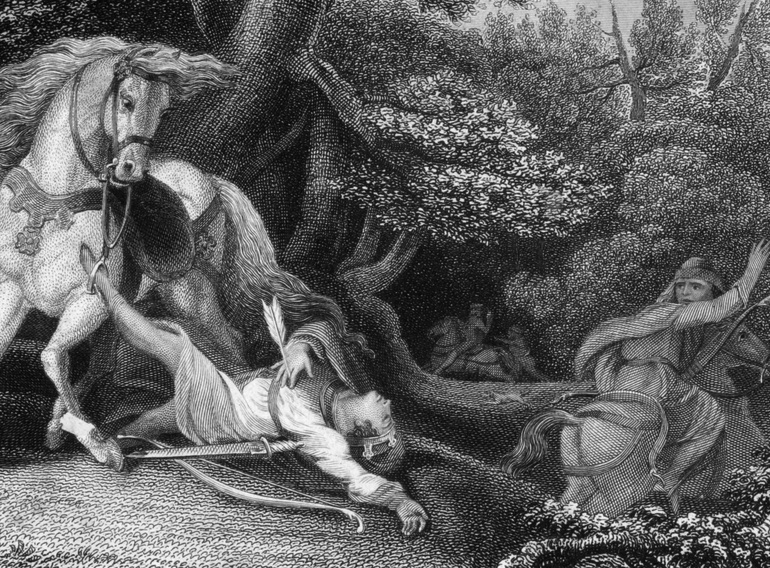
King William II (Rufus the Red) was killed while out hunting in the New Forest – was it an accident or was it murder?
On this day 926 years ago occurred an incident in the New Forest that continues to be debated among scholars today.
King William II, also known as Rufus the Red (possibly because of his ruddy complexion or hot temper), who ruled England from 26 September 1087 until 2 August 1100, was struck down by an arrow and killed while out hunting. While it is not known whether his death was regicide or accident the circumstances are nevertheless suspicious. Also in the hunting party at the time was William II’s younger brother, Henry. On learning of his brother’s death Henry galloped off with indecent haste to Winchester to take possession of the royal treasury and from there on to London to become crowned King Henry I. It was the speed of this decision that has given rise to speculation that the accident was in fact premeditated regicide.
Born in 1056, William II was the third and favourite son of William the Conqueror and Matilda of Flanders. His eldest brother Robert II (better known as Robert ‘Curthose’, which basically meant ‘shorty-pants’) inherited their father’s title as Duke of Normandy in 1087. Another older brother, Richard – often referred to as Duke of Bernay – had died between 1069 and 1075. According to William of Malmesbury, the 12th century historian, Richard had “contracted a disorder from a stream of foul air while hunting deer in the New Forest.” This meant that it was Rufus who had inherited the crown of England to become William II.
Abhorrent to God
William II was described as ‘well set; his complexion florid, his hair yellow; of open countenance; different coloured eyes, varying with certain glittering specks; of astonishing strength, though not very tall, and his belly rather projecting’.[1] Very few people seem to have mourned his death. His subjects regarded him as tyrannical, malevolent, and greedy. His relations with the church were no less fraught. According to the Anglo-Saxon Chronicle William II was ‘hated by almost all his people and abhorrent to God’.[2] Unusually for a medieval king he was not at all religious. For most of his reign he was in dispute with his clergy and used church revenues as his own private piggy bank. He took over the Archbishop of Canterbury’s revenues, for example, when Archbishop Lanfranc died in 1089 and kept other bishoprics vacant to make use of their revenues. He had numerous arguments with Lanfranc’s replacement, Anselm of Canterbury, and the king’s behaviour exiled the popular cleric meaning that even more of the churches revenues were available to the avaricious king. (Anselm died in 1109 and was later canonised.)
It is small wonder that William II has sometimes been associated with the pagan “Old religion”.[3] In truth, he would probably have been better described as ‘ungodly’ and much of his life has been interweaved with tales of (black) magic and myth. He was also irreverent, followed flamboyant fashions and even wore his hair long. He didn’t marry, nor did he have any children, so rumours abounded that he was homosexual. Of course, the chroniclers of the time were clergymen and accusations of blasphemy, and his ‘effeminacy’ and ‘immorality’ would have served their own public relations purposes. If they had had any evidence to back up their claims, they would have produced it. Surely?
Portents and omens
According to some chroniclers many ‘marvels’ were supposed to have presaged William II’s demise, including brooks bubbling with blood, bad weather and signs and visions that appeared in England and foretold the king’s death. In the days leading up to his demise, reports were made of unearthly portents. It was said that: ‘In his thirteenth year [of his reign i.e. 1100] … there were many adverse events; but the most dreadful circumstance was that the devil visibly appeared to men, in woods and secret places, and spoke to them as they passed by’.[4] The King was reported to have had disturbed dreams the night before he died, to the extent that he asked Robert Fitz-hamon to bring him a light and not to leave him.[5] Fitz-hamon then related to William Rufus that a monk had had a vision and warned them not to go hunting. The King allegedly laughed this off, but he seems to have been disquieted, nonetheless. The hunting party delayed their departure until much later in the day by which time they had had a good dinner and more than the usual quantity of wine.[6]
Death in the Forest
Before the party set off, a letter arrived from Abbott Serlo of Gloucester warning of a premonition of the king’s death. Typically, in his disdain for members of the clergy Rufus is said to have dismissed the letter, saying that he had no interest in the ‘dreams of snoring monks.’[7] Hunting was not just a favoured pastime for securing meat for the table but was also a method for nobles of honing their skills and fitness for battle. Hunting deer and wild boar required bravery, strategy, and endurance – all the requirements needed in warfare. It also demanded familiarity with weaponry – the lance, sword, and bow. Orderic Vitalis, an English chronicler and contemporary of the King, said that that while preparing for the hunt, a smith presented the King with six arrows. He is supposed to have kept four for himself and given the other two to Tirel [Sir Walter Tyrell] saying; ‘it is only right that the sharpest arrows go to the man who knows how to inflict the deadliest shots.’[8]
The events that led to the king’s death shortly after are generally accepted to be either that Tyrell shot the king by accident or that Tyrell’s arrow deflected killing the king. The light was apparently poor, with the sun low in the sky, due to the delay in setting out on the hunt. Tyrell is said to have denied the killing even on his deathbed (which would have put him in serious peril of his soul if he had lied). In any case all his companions left William II where he fell and ran away. It was left to a charcoal burner, named Purkis, to recover the King’s body and carry it on a cart to Winchester for burial. (Descendants of Purkis are still living in the area of the New Forest today.)
Coronation Edict 1100AD
Henry who, unlike his brothers, had initially only inherited money from his father, now became King Henry I. Walter Tyrell fled abroad and though he never returned to England his estates remained intact and passed to his heirs, which has further fuelled the suspicion that Henry arranged or was at least complicit in the assassination of his brother. Even though his people had loathed William II his reign had at least one beneficial legacy that has resounded through the ages. Henry I, the fourth son of William the Conqueror, on ascending the throne in 1100 issued a royal proclamation – the Coronation Edict, which was regarded as atonement for the past abuses of his predecessor and brother. Henry I’s Coronation Edict specified a number of rights to the church, landowners, heirs and even widows. Over a hundred years later, when the barons and the church fell into dispute with King John, the Coronation Edict was rediscovered and the idea of a new and improved document was seized upon, which became Magna Carta (passed in 1215). Had William II known that as a result of his reign such a document would emerge to protect against bad rulers, he would probably have seen red!
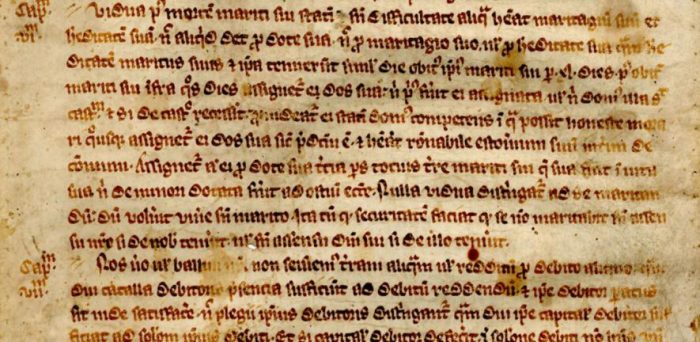
Magna carta was issued on 12th June 1215.
[1] Rev. Joseph Stevenson, ‘The Fourth Book of William of Malmesbury’s History of the Kings of England, Book IV’ in The Church Historians of England (London, 1854) p.282.
[2] The Laud Chronicle (E0 1099 in The Anglo-Saxon Chronicle (Rutgers University, 1953) p.235.
[3] Margaret Alice Murray, The God of Witches (London, 1952)
[4] Rev. Joseph Stevenson, ‘The Fourth Book of William of Malmesbury’s History of the Kings of England, Book IV’ in The Church Historians of England (London, 1854), p.283.
[5] Edward A. Freeman, The Reign of William Rufus and the Accession of Henry the First (Oxford, 1882), p.328.
[6] Rev. Joseph Stevenson, ‘The Fourth Book of William of Malmesbury’s History of the Kings of England, Book IV’ in The Church Historians of England (London, 1854), p.284.
[7] Marjorie Chibnall, The Ecclesiastical History of Orderic Vitalis, Volume V, Books IX and X (Oxford, 1969), p. 289.
[8] Ibid.


You must be logged in to post a comment.